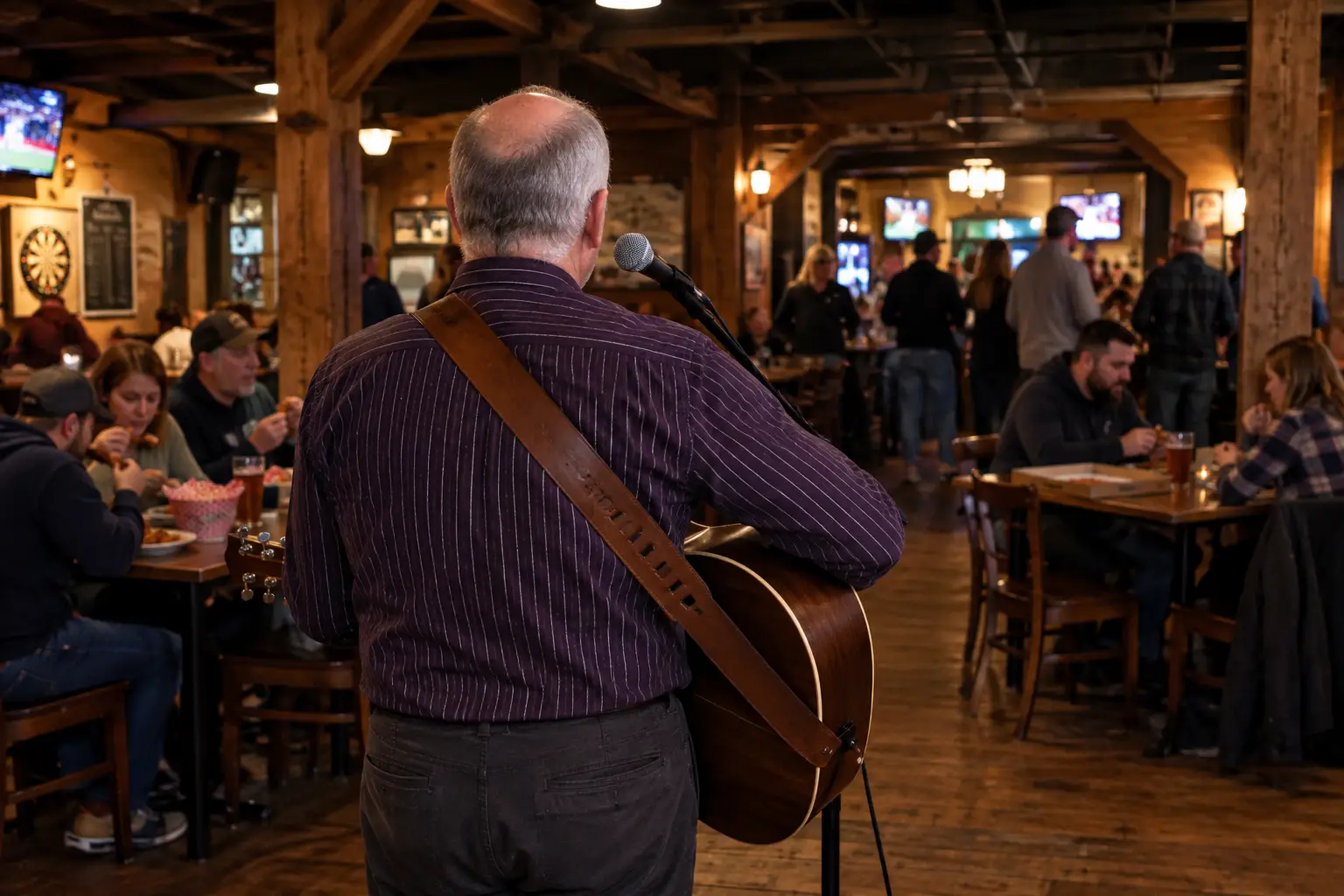
Set the guitar at the front door. Dressed appropriately for a 60-year-old. Truck keys in hand.
Grab the guitar. Lock the door. Get in the truck.
Committed.
No backing out now.
The 30-minute drive to Hobbs gives me time to reflect on the dues I've paid as a musician over the years. And I realize something:
It's not the number of dues that matters. It's the intensity of each one.
More on that later.
I owe this open mic experience to myself.
This is the grit part.
I arrive at Hobbs, grab my guitar and walk through the front door. The sign says:
OPEN MIC NIGHT TONIGHT
7–9 PM
HOSTED BY JON
I climb the stairs and say hello to Jon. He's testing his P.A., guitar sound and microphone. He asks me to remind him of my name.
I'd been to a couple of open mic nights as a spectator. I'd chatted with Jon, told him I played and said I was interested in performing sometime.
Well, sometime had arrived.
I stow my guitar by the pool table.
Now the body starts keeping score.
Nerves. Dry mouth. Slightly elevated heart rate. Clammy hands.
I scan the room to see who else might be taking the stage.
There are around 75 people, most of them there for a dart-throwing championship in an adjacent room.
The last time I'd been here, my wife and I were eating pizza and watching the open mic with maybe ten other people.
Tonight was different.
My first solo open mic attempt was going to be witnessed by a hell of a lot more people than I anticipated.
Figures.
Mission Briefing
Six performers tonight, including me.
I recognize two of them from previous open mics. One is Pedro. He offers up a couple of originals along with a cover or two. Strong voice. Heavy hand. I like a couple of his melodies. His lyrics are straightforward, almost storytelling. I think one of his songs involves drinking whiskey.
Jon asks me if I'm ready.
Time to find out.
I head up, pull out my guitar, plug in and play a few notes.
Tinny.
Not good.
My Taylor is the nicest guitar I've ever owned. It came with a stock pickup. Taylor isn't known for great pickups, as I would eventually learn. Many Taylor enthusiasts replace them.
I've never been happy with the amplified sound of mine.
Unamplified, it's warm, with a rich tone.
Plugged in, all that richness disappears. What's left is a metallic thinness that sounds like the cheapest secondhand guitar you could imagine.
I've owned a couple of those.
Last century.
Showtime
I had rehearsed a goofy introduction:
“Hellooooo O-sip-E. Home of the first snow MO-bih-LAY.”
Nothing.
No response.
My joke falls flat.
Good start.
I'm in Ossipee, pronounced Oss-ih-Pee, noted on the road sign as the home of the first snowmobile.
I start playing.
Cold fingers.
Elevated heart rate.
Dry mouth.
Nerves.
One of my songs is political.
I play three songs and receive polite applause.
Later, one of the other performers gives me some friendly advice: don't sing political songs if you want to win over an audience.
Advice duly noted.
And silently rejected.
I'm not playing songs to delight an audience.
I'm playing songs to express my thoughts and purge my mind.
It's my freedom of speech, exercised.
It's cathartic.
I've got something to say.
And the punk in me wants some confrontation and discomfort.
I have no intention of playing a full set of cover songs about drinking and getting stupid.
The guy who bestowed his wisdom on me had done a crappy version of a Johnny Cash song.
I like Johnny Cash.
I gave him polite applause.
Debrief
On the drive home, I reflect on the experience.
What did I do well?
What didn't I do well?
Mostly, I'm proud of myself for doing it.
There is a LOT OF ROOM FOR IMPROVEMENT.
But that's the nature of paying dues.
The experience is the teacher.
My goal for playing open mics is not to become some great entertainer overnight. It's to put my songs in front of people, become a better musician and songwriter, and—perhaps equally important—get to know other musicians like Pedro and Jon.
A few weeks later, I do another open mic at Hobbs.
This time it's me, Jon, the bartender and no more than five other people.
The open mic nights aren't exactly a draw.
That means it's incumbent upon me to invite people to come check it out.
That will be a future 56-day challenge.
But tonight, there's another lesson waiting.
My pickup gives up the ghost during my first song.
Try changing the battery.
Nope.
I end up putting a microphone in front of my guitar and finish the set that way.
My hands are a little clammy, making my guitar work less than fluid.
Another due.
But a relatively small one.
There isn't much at stake when hardly anyone is there.
It would have sucked a lot more if I'd invited acquaintances, coworkers and friends.
And that brings me back to intensity.
The Dues Get More Expensive
When I was 17, I was in a cover band called Zipper.
We covered Iron Maiden, Def Leppard, Judas Priest, Motley Crue and others.
We wore spandex.
We grew long hair.
And on one particular gig at a Long Island club, we were out of tune.
I'd invited my two best friends to see us.
We didn't have a tuner, so tuning was done entirely by ear.
I couldn't get in tune with Sean, the lead guitarist.
Zipper made me sit out the set.
The audience numbered fewer than ten people, including my friends.
To this day, that was the most painful due I've ever paid.
Humiliation.
Anger.
I swore it would never happen again.
Nowadays, the digital tuner is fundamental and convenient.
Lesson learned.
Another due came at an open mic night with my housemates in The 9-to-5 Curran Street Band.
Our address was 925 Curran Street in Atlanta, a house that has since been demolished—with our assistance.
The place had been condemned and we were getting evicted. They planned to level it, so we decided we'd had a green light to have one last bash.
Bring your own sledgehammer.
A dozen college buddies spent the day destroying the place.
Walls.
Doors.
Windows.
We even knocked the chimney off the roof.
It was tremendous fun.
Back to the open mic.
Don, the bassist, got drunk, as usual.
I felt we were completely unprepared to play.
This was my first time as lead singer and guitarist, and I had a deer-in-the-headlights moment.
I choked.
Later, at the Majestic Diner on Ponce in the wee hours of the morning, Dave, another housemate, suggested we look for a lead singer.
I wasn't surprised.
I was nevertheless crushed.
Another due.
Then there was the established Atlanta band I played in when we had developed a decent local buzz after releasing our first CD.
We were onstage supporting a local radio station.
The bass player and I were having words.
I wouldn't air our dirty laundry in public.
He had no such social barriers.
He proceeded to tell me, loudly, to get my shit together.
That would have pissed me off if it had happened in our rehearsal space with the three of us.
In front of a hundred people—many of whom we knew personally—it was something else entirely.
It was embarrassing.
And it would prove to be another nail in the coffin for his short-lived time with the band.
I remember that confrontation more clearly than I remember the set.
The audience may have gotten some entertainment out of the spectacle.
For all I know, that was the best part of the show.
Mission Accomplished
On this 56-day Shedooby challenge, my personal goal was to play two open mic nights.
These were the first solo open mic performances I've ever done.
Mission accomplished.
My reward?
A new acoustic pickup.
And man, does this new pickup bring out the warm tones of my Taylor.
More importantly, I learned a lot.
I learned how to use my guitar more as an accompaniment to my voice—and my voice more as an accompaniment to the guitar.
I learned to vary my picking hand and my touch, from soft to aggressive.
I learned to sing dynamically, sometimes quietly and sometimes louder.
I learned how to keep engaging an audience even when something goes wrong.
And I learned to take an extra minute before starting to make sure I can hear the guitar tone, volume and microphone properly.
Every one of those lessons came from paying a due.
The Shedooby Method
This is what Shedooby is about.
Building grit.
But grit isn't blindly throwing yourself into increasingly difficult situations.
There has to be situational awareness.
You have to think about the environments, domains and support networks that give you the best odds of success.
It's a head game.
And it requires intentional action.
Start small.
Set an attainable goal.
Get the first few out of the way.
Then raise the stakes.
The goal isn't to avoid discomfort.
The goal is to use discomfort.
Pay the dues.
Learn from them.
Build capacity.
Then pay a bigger due.
I don't know if it can be called addictive, but it is damn exciting to see real progress.
That's Shedooby.
Train the mind.
Pay the dues.
Build the grit.
Next mission.